

| Posted in: MRES Today Stories
Late on the night of Jan. 23 and into the early morning hours of Jan. 24, 2026, Winter Storm Fern began tightening its grip across much of the country. What started as forecasted cold temperatures quickly expanded into a widespread system of ice, snow and subzero air stretching from the Midwest into the Southeast and eventually pushing demand higher in the Northeast. As conditions worsened, power systems across multiple regions were placed under strain. For Missouri River Energy Services (MRES), the storm became a real-time test of generation availability and coordination.
“Early on, we weren’t getting any major escalation notices from MISO (Midcontinent Independent System Operator) and SPP (Southwest Power Pool),” Austin Hoekman, MRES director of energy supply and operations said. “We knew it was going to be cold, but nothing suggested it would turn into a significant event.”
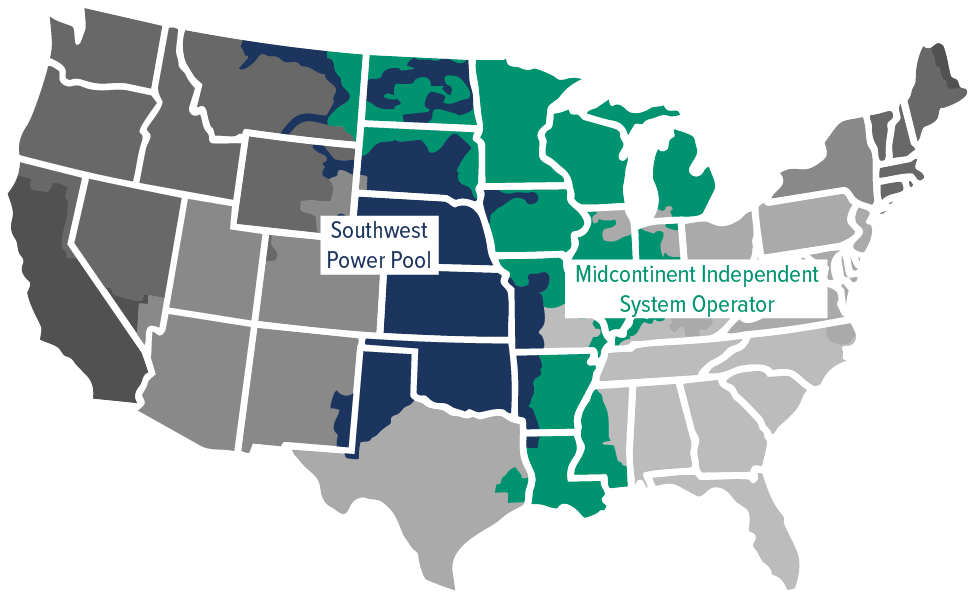
That changed late that night. Around 11:30 p.m., market alerts escalated, and by 3:30 a.m., MISO had declared a higher-level energy emergency. Municipal generation units in MISO were called upon to
start at 6 a.m., giving operators only a few hours to coordinate.
At the same time, MRES was managing an unexpected outage at its 280-megawatt share of the Laramie River Station in Wyoming. A mechanical issue had sidelined the unit just days before the storm.
“It was really unlucky timing that it happened the week we needed it most,” Hoekman said.
For all the units called to run, fuel supply was not a concern, thanks to preparation following earlier winter events. “We were prepared and our operators worked really well with suppliers to ensure we had enough to run,” he said. “Fuel never became the issue for us. We learned from Winter Storm Uri in 2021 and made sure we were proactive.”
"We were prepared and our operators worked really well with suppliers to ensure we had enough to run,” he said. “Fuel never became the issue for us. We learned from Winter Storm Uri in 2021 and made sure we were proactive.”
Even so, additional mechanical challenges at other units added pressure. Market prices rose during Fern, but not to historic levels. “It was a storm we were well equipped to handle,” he said.
The contrast with Winter Storm Uri in February 2021 is significant. Uri was largely centered in the Southwest Power Pool (SPP), where extreme cold settled over southern SPP and Texas for several days. Natural gas production froze, wind generation dropped sharply and many gas-dependent plants were forced offline.
“The biggest factor during Uri was that it hit squarely in SPP,” Hoekman said. “And because of how our portfolio has evolved over the last 40 to 50 years, we had surplus generation in that region.”
Even in the colder winter months, MRES had more generation available in SPP than it needed to serve its own load, including its share of Laramie River Station, along with Exira, Watertown and behind-the-meter generation and the units performed reliably during the event.
Fuel supply was not a constraint during Fern, reflecting proactive planning and lessons learned from prior winter events, like Uri. Even so, additional mechanical challenges at other aging facilities added operational pressure. While market prices increased during Fern, they did not reach the extraordinary levels seen in Uri. As a result, the financial outcome was less favorable than in past events, though reliability was maintained and no negative rate impact is projected for members.
Together, Fern and Uri show how two winter storms can have different impacts. Uri demonstrated the financial benefit of surplus generation during a southern states market crisis. Fern highlighted how the unexpected loss of a major resource during a MISO-driven event can shift the outcome, even with strong preparation and fuel planning.
“Our hedging program performed as expected,” Hoekman added. “It’s not projected to have a negative rate impact for members.”
In both storms, reliability remained the priority. “These winter events are serious,” he said. “We plan for them every year. The goal is always to keep the lights on and protect our members.”