

| Posted in: MRES Today Stories
A major technology project completed in mid-October is giving Missouri River Energy Services (MRES) a clearer view of its generation resources — and laying the groundwork for a significant change in how member-owned generators participate in regional energy markets.
The new supervisory control and data acquisition (SCADA) system provides real-time visibility into generation assets, helping MRES operators monitor output, identify issues and respond to changing conditions. According to Austin Hoekman, director of energy supply and operations, it also supports efforts to move member generation from “behind the meter” to “in front of the meter,” preserving the value of those resources as market requirements evolve. “It’s a significant change in the way we operate,” he said.
SCADA brings operating information together so staff can see what generation resources are doing, second by second, and take action if deemed necessary, either through SCADA or other means. For MRES, that visibility is increasingly important as its resource mix expands.
Planning began in 2022, driven partly by the monitoring needs of MRES generation Marshall Solar Plus and other projects, including Brookings Solar, which began operation in September 2026. Both projects are unique in that they interconnect to member distribution systems, the first of their kind owned by MRES where real-time remote visibility was needed. MRES also needed to replace aging software that was no longer supported.
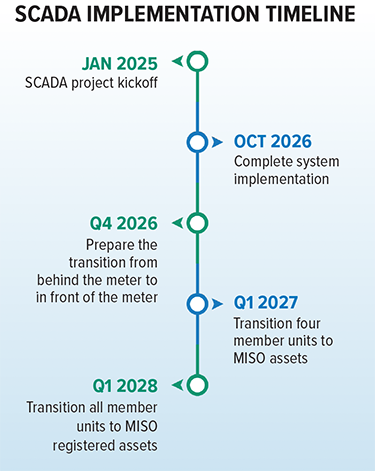
MRES moved forward with vendor selection in 2024 and launched implementation in January 2025. The approximately $1 million project finished close to budget.
Operations, information technology and generation resources staff worked alongside DGR Engineering to implement the system. After several months of parallel operation and troubleshooting, MRES switched to the new platform in mid-October.
The system’s capabilities extend beyond today’s needs, potentially supporting additional generation monitoring, controls and other applications.
One of the first projects to leverage the SCADA system capabilities involves changing how member-owned generators under reserve capacity agreements are registered with the Midcontinent Independent System Operator (MISO).
“It’s [SCADA system] a significant change in the way we operate."
—Austin Hoekman, director of energy supply and operations
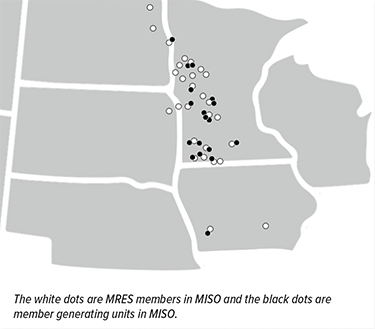
Currently, these generators generally participate as load-modifying resources. When they operate, MISO sees a reduction in a community’s electricity demand rather than the generator’s individual output.
Registering them as market generation resources will allow MISO to see that output separately and commit the units based on market needs and operating parameters.
Moving “in front of the meter” describes this registration change. It does not require changing the generators’ physical connections to local distribution systems. Member operators will continue operating their units locally, with additional communications equipment installed where needed.
The primary goal is to protect capacity accreditation — the credit these generators receive toward meeting resource adequacy requirements.
MISO’s changing requirements under the existing registration include a shorter notification window for certain load-modifying resources, dropping from two hours to 30 minutes. That presents practical challenges when operators must be contacted and travel to generation sites.
“Thirty minutes notice is not feasible,” Hoekman said.
Market registration offers a path to preserve capacity value while establishing operating parameters, including notification and minimum run times. MRES will seek longer notice where possible, although those arrangements remain subject to market requirements.
MRES is targeting four generating units, two each in Marshall and Detroit Lakes, for the first quarter of 2027. The remaining participating MISO member generators are targeted for transitions by March 1, 2028, ahead of the 2028–29 MISO planning year.
Members can expect closer coordination with MRES on availability, fuel costs and operating capabilities.
The work ahead is substantial, but its purpose is clear: preserve the value of member investments while supporting reliable service.
“It’ll be a lot of work,” Hoekman said, “but at the end of the day, it’s in the best interest of our members.”