

| Posted in: MRES Today Stories
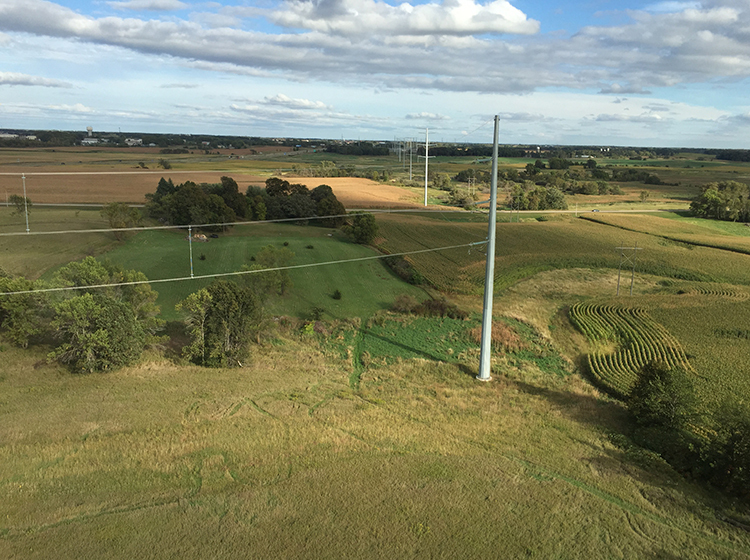
As energy demand grows and the generation landscape continues to evolve, MRES is working to help advance major transmission investments designed to strengthen reliability and support long-term regional and member needs.
According to MRES Director of Transmission Richard Dahl, these efforts represent a coordinated approach to reinforcing regional 345-kilovolt (kV) transmission while also improving reliability closer to the communities it serves.
While transmission lines may appear as simple structures from the road, developing them requires long-term planning and complex engineering and routing. Many of the large projects now underway were identified through the Midcontinent Independent System Operator’s (MISO) Long Range Transmission Planning (LRTP) process. This regional effort evaluates future grid needs across the MISO footprint, helping identify upgrades that maintain reliability, improve resilience during extreme weather, reduce congestion and increase access to lower-cost energy.
The 345-kV projects involving MRES are a key part of that broader regional strategy.
One significant project is the Big Stone South to Alexandria (BSSA) 345-kV project, co-owned with Otter Tail Power Company. Currently advancing through development, including Minnesota’s route permitting process, the line will create a new high-voltage connection between the Alexandria, Minnesota, area and Big Stone City, South Dakota area. This transmission line will increase transfer capability and strengthen reliability across western Minnesota and eastern South Dakota, while also helping relieve congestion on the regional grid.
Closely tied to BSSA is the Alexandria to Big Oaks (ABO) 345-kV project, developed in partnership with the CapX Fargo owners that also includes MRES/Western Minnesota Municipal Power Agency (WMMPA). This line will connect Alexandria to an area near Becker, Minnesota, further enhancing the regional transmission network. Planning and coordination efforts continue as the project moves through development milestones. “The ABO project complements BSSA,” Dahl said. “Together, they strengthen the regional transmission system and improve reliability.” The BSSA and ABO projects, which come with substantial expansion of the MRES Alexandria Substation, are part of MISO’s Tranche 1 LRTP projects.
In addition, early development is underway for a second 345-kV circuit between the Bison Substation near Fargo, North Dakota, and the Alexandria Substation. Like the other major projects, this line was identified through MISO LRTP process but is part of the Tranche 2.1 portfolio of board-approved projects.
“Transmission is what connects generation to the communities that need power. These projects help ensure that as the electric grid evolves, our members will continue to have reliable service.”
Along with these large-scale investments, MRES is also addressing more localized transmission needs in collaboration with utility partners.
In western Minnesota, progress continues on the Appleton to Benson 115-kV project. Plans include construction of a new Appleton Substation to replace the existing facility, along with upgrades to the high side of the Benson Municipal Utilities Substation. Engineering and design work are underway, with the project aimed at enhancing reliability for the local area. The project has received a Certificate of Need and Route Permit from the Minnesota Public Utilities Commission. MRES/WMMPA will own the 115-kV side of the Benson Municipal Substation and the new Appleton Substation. A detailed schedule is presently being developed for the project expected to be completed in a few years.
“While it’s a lower voltage than the 345-kV projects, this investment is just as important locally,” Dahl said. “It provides additional support and operational flexibility for communities like Benson, Minnesota.”
All transmission projects must also move through a rigorous permitting and regulatory process before construction begins, including certificates of need, route permits, or alike and other approvals from state and federal agencies. Projects such as BSSA and the Bison–Alexandria second circuit are currently progressing through these steps.
Collectively, these transmission investments position MRES to meet future demand and support reliability for members for decades to come.
“Transmission is what connects generation to the communities that need power,” Dahl said. “These projects help ensure that as the electric grid evolves, our members will continue to have reliable service.”
That evolution is already underway. Across the Upper Midwest, the energy system is changing as new renewable generation comes online and older plants retire. At the same time, demand for electricity continues to grow. These shifts are placing increasing pressure on the existing transmission system.
Projects like BSSA directly address these challenges. As one of 18 major transmission projects identified in MISO’s Tranche 1 portfolio, BSSA and the other projects are designed to enhance reliability, improve resilience to extreme weather, reduce congestion and expand access to lower-cost energy across the region.
LEARN MORE ABOUT EACH OF THESE PROJECTS
Big Stone South – Alexandria (BSSA) 345 kV